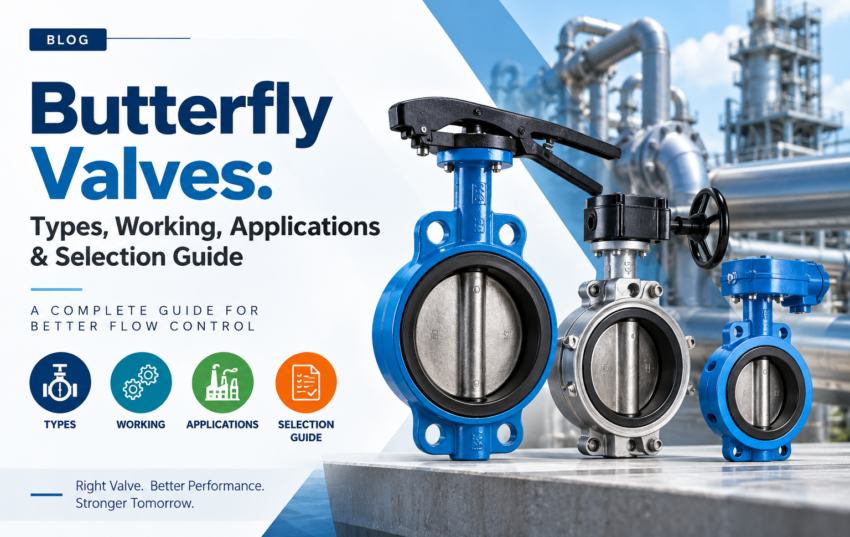
Industrial butterfly valves from Parth Engineering control liquids, gases, air, and process media across pipelines. Its listed range includes stainless steel, wafer, sandwich, double-flanged, and pneumatic-actuated options for manual or automated duties. Yet performance depends on more than nominal size. Disc design, seat material, pressure class, temperature, connection style, and actuator torque must match the service. This butterfly valve types and selection guide helps engineers, contractors, procurement teams, and plant owners compare configurations, prepare accurate enquiries, and request a technically suitable quotation from Parth Engineering.
Direct Answer
Parth Engineering’s butterfly valve controls or isolates pipeline flow through a circular disc rotating approximately 90 degrees. The disc aligns with the flow to open and turns across the passage to close. Choose the model by matching fluid, size, pressure, temperature, shutoff requirement, connection, materials, operating method, automation needs, and standards.
What Is a Butterfly Valve?
A butterfly valve is a quarter-turn valve comprising a body, disc, stem, seat, seals, and operator. Turning the stem smoothly rotates the disc. The open disc presents a small obstruction, while the closed disc presses against the seat to stop flow. Intermediate positions can provide throttling when the valve and actuator are sized for control duty.
Its short face-to-face length, low weight, operation, and modest installation space make it attractive for large industrial pipe diameters. Compared with many gate or globe valves, it requires less support and faster actuation. Parth Engineering serves water treatment, HVAC, chemical processing, pharmaceutical, food, oil and gas, and general industrial applications.
A pipe jointer is not automatically a precise pressure control valve. A jointer connects pipe sections, while a control valve must be engineered for stable modulation, pressure drop, cavitation risk, and control range. Correct terminology prevents an expensive specification mismatch.
Butterfly Valve Types and Selection Guide
Define the Process Conditions and Required Function
Begin with a written process datasheet, not a catalogue image or quoted price. Record the fluid name, concentration, solids content, viscosity, normal and maximum flow, line size, design pressure, operating temperature, and possible cleaning chemicals. State whether the valve will provide isolation, emergency shutoff, or modulation. For throttling, include upstream and downstream pressures, expected pressure drop, and desired control range.
Also define shutoff class, permitted leakage, operating frequency, flow direction, and fail position. A valve cycling twice yearly has different bearing and actuator demands from one moving every minute. Slurries may erode exposed seats; dry powders can pack around the disc; steam and hydrocarbons may require metal seating and fire-tested construction.
Confirm the true differential pressure at opening and closing. Actuator torque is influenced by disc size, seat friction, velocity, and pressure—not nominal line pressure alone. Ask the supplier to document seating, unseating, and dynamic torque with an appropriate safety factor. This first step eliminates unsuitable designs before comparison and gives Parth Engineering the information needed for accurate technical selection.
Select the Disc Geometry and Seat Design
The butterfly valve types are concentric, double-offset, and triple-offset designs. In a concentric valve, the stem passes through the disc centre, and it remains in contact with an elastomeric seat during travel. This economical arrangement suits water, air, and low-temperature services where soft seats provide tight shutoff.
A double offset butterfly valve moves the shaft away from the pipe centreline and seat-contact plane. The disc lifts from the seat quickly as it opens, reducing rubbing and extending service life. It is considered for higher temperatures, pressures, or cycling duties than a basic concentric design.
A triple offset butterfly valve adds conical sealing geometry. Its sealing surfaces approach contact mainly at final closure, minimizing sliding friction. Metal-seated versions suit demanding steam, hydrocarbon, high-temperature, and critical isolation services when specified.
Do not select by offset count alone. Ask Parth Engineering to confirm geometry, leakage rating, seat replaceability, bidirectional performance, pressure-temperature limits, and maintenance needs. The simplest design meeting the duty offers best lifecycle value; severe service deserves engineering evidence, not a label.
Choose the Body Connection and Check Installation Fit
Parth Engineering lists a wafer-type butterfly valve fitting between flanges and retained by studs. This compact option is economical where the line remains intact. The terms wafer butterfly valve and sandwich type butterfly valve describe the between-flange arrangement, although details vary by design.
A lug type butterfly valve has threaded body lugs. A lug butterfly valve accepts separate bolts from each side, which may permit downstream piping removal when its rating and instructions allow dead-end service. Not every lugged valve has that capability.
Verify flange drilling, pressure class, face-to-face dimension, gasket practice, bolt clearance, disc swing, and nearby fittings. The disc must not strike the pipe bore, liner, check valve, or reducer. ISO 5752 covers standardized face-to-face series for metal valves, while ASME B16.5 addresses mating flange details.
Match Materials, Seat, and Actuation to the Application
Select wetted materials from chemical compatibility data and temperature, not appearance. Ductile iron bodies with EPDM seats are common in water service. NBR often suits oils, while PTFE provides chemical resistance but has distinct pressure, temperature, and torque behaviour. Confirm potable-water, food-contact, fire-safe, antistatic, or fugitive-emissions approvals.
Parth Engineering lists a stainless steel butterfly valve, but “stainless” is incomplete. Specify the body, disc, stem, fasteners, and alloy grade. An SS butterfly valve with a stainless disc but an unsuitable seat or stem can fail in corrosive media. Chlorides, acids, solvents, and cleaning cycles deserve materials review.
Choose a lever for small manual valves and a gearbox for larger sizes. A pneumatic butterfly valve provides automation where instrument air is available. Specify a double-acting or spring-return butterfly valve with pneumatic actuator, fail-open or fail-closed action, supply pressure, cycle time, position indication, solenoid, and positioner.
For modulating duty, confirm sizing, controllable angle, actuator resolution, and system dynamics. Large valves operate near closed, creating unstable control, noise, vibration, and premature seat wear.
Verify Standards, Testing, Manufacturer Capability, and Support
Before ordering, request a datasheet, arrangement drawing, pressure-temperature chart, material specification, torque data, inspection plan, and test certificates. Requirements may include API 609, EN 593, ISO 5752, flange standards, and project-specific leakage tests. For automated assemblies, ISO 5211 defines attachment requirements for part-turn actuators; the mounted unit needs functional testing.
Evaluate the factory, not sales claims. Valve manufacturers should demonstrate design control, traceability, calibrated testing, machining capability, quality records, and engineering support. When comparing valve manufacturers in India, review references for similar fluids and conditions. Butterfly valve manufacturers should explain exclusions clearly.
Parth Engineering is a valve manufacturer in Ahmedabad, Gujarat. Buyers search for lug butterfly valve Manufacturer In Ahmedabad.
Ask each butterfly valve supplier to quote the same datasheet. Compare warranty, spares, lead time, documentation, support, and installed cost. A capable valve manufacturing company will resolve deviations in writing before accepting the order.
Practical Examples and Quick Comparison
For a compatible cooling-water header, a Parth Engineering stainless steel wafer valve may provide reliable, compact isolation. A double-flanged version may suit installations requiring a more rigid pipe connection. For automated process duty, its pneumatic-actuated option can provide fast remote operation when correctly sized and properly configured.
| requirement | Likely starting point | Why |
| Clean water or HVAC isolation | Concentric wafer valve | Compact, economical, and fast to operate |
| Sectional pipe maintenance | Lugged soft-seated valve | Independent-side bolting may support approved dead-end service |
| Frequent cycling or higher temperature | Double-offset design | Reduced seat rubbing can extend service life |
| Critical high-temperature isolation | Triple-offset metal-seated design | Low-friction seating suits demanding service |
| Automated on/off operation | Pneumatic assembly | Fast cycling and defined fail action are available |
These are practical starting points, not final specifications. Fluid chemistry, differential pressure, velocity, leakage limit, size, standards, and safety requirements can change the answer—request written selection confirmation from Parth Engineering before ordering.
Common Selection Mistakes
One frequent mistake is buying by size and lowest price while ignoring differential pressure, temperature, chemistry, and leakage performance. Another is assuming every PTFE, EPDM, or NBR seat behaves identically.
Do not install a valve before checking disc clearance, flange alignment, gasket guidance, bolt sequence, and flow direction. Pipe stress, welding debris, and overtightened fasteners can distort the seat and create leakage.
Valve companies in India are useful for discovery, not qualification. Do not accept unsupported claims, oversized actuators, or unrelated certificates. Avoid treating every butterfly valve as ideal for throttling. Control duty requires sizing and cavitation, noise, velocity, and operating-angle checks. Technical review costs far less than shutdown, replacement, and lost production.
Conclusion
Share a datasheet with Parth Engineering, confirm pressure-temperature limits and shutoff performance, and evaluate lifecycle support before price. Request a technically reviewed recommendation and an accurate, competitive quotation from Parth Engineering today.
Frequently Asked Questions
1. How does a butterfly valve work?
An operator turns the stem and disc through roughly 90 degrees. The disc aligns with flow to open, rotates across the passage to throttle, and seals against the seat when closed. Sealing and torque depend on geometry, materials, pressure, and temperature.
2. Which Parth Engineering butterfly valve should I choose?
Choose a Parth Engineering wafer or sandwich valve for compact installation, a double-flanged model for robust piping connections, and a pneumatic-actuated model for automation. Final selection must match the process medium, pressure, temperature, leakage target, material compatibility, and required standards.
3. What is the difference between wafer and lug valves?
Wafer valves are clamped between flanges using through-bolts, producing an economical installation. Lug valves use threaded body lugs and separate bolts from each side. Certain rated lug designs support downstream pipe removal; confirm dead-end limits with the manufacturer first.
4. Can a butterfly valve control pressure?
It can modulate flow and indirectly influence downstream pressure when sized with an actuator and control system. It should not be substituted casually for a purpose-selected pressure regulator. Engineers must examine pressure drop, cavitation, noise, rangeability, velocity, and fail-safe behaviour.
5. How do I request a quote from Parth Engineering?
Send Parth Engineering the fluid, concentration, line size, pressure, temperature, flow rate, connection standard, material preference, operating method, and quantity. Add actuator supply pressure and fail action for automation. The team can then review suitability and prepare a relevant quotation.